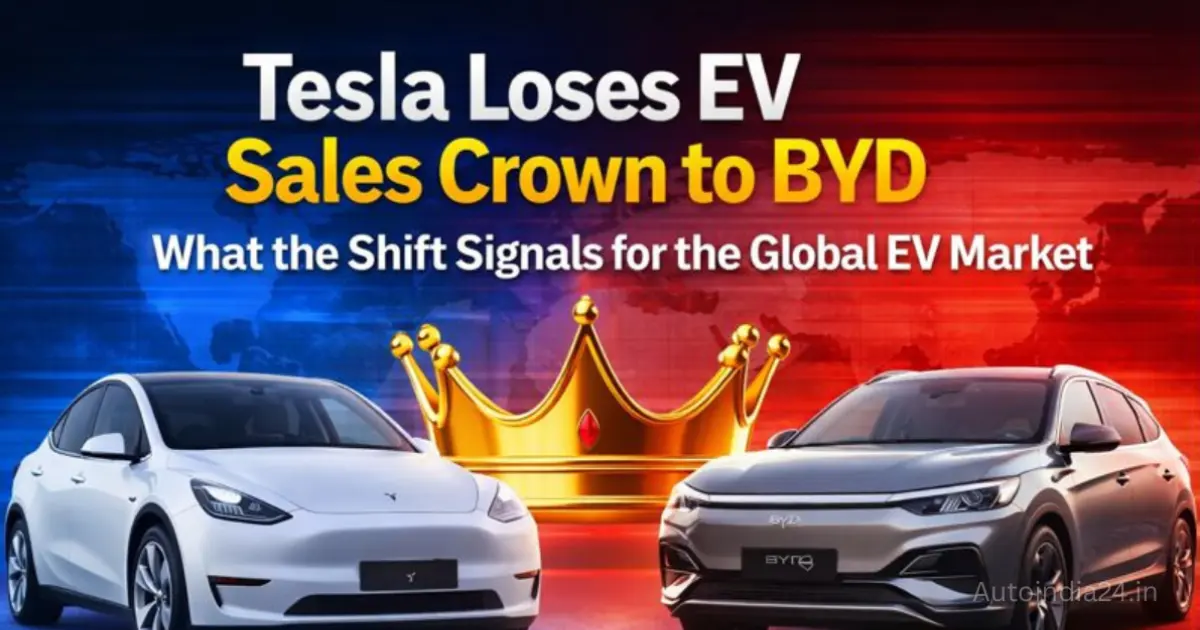
Tesla Loses EV Sales Crown: The global electric vehicle (EV) market witnessed a significant realignment in 2025, with Tesla losing its long-held position as the world’s largest electric carmaker to China’s BYD. After two consecutive years of declining vehicle deliveries, Tesla now trails BYD by a substantial margin, highlighting how the competitive dynamics of the EV industry are evolving beyond early-mover advantage and brand perception.
Also Read: Ola Electric Market Share Falls Sharply in 2025 as TVS, Bajaj Gain Ground
Sales Numbers Reveal a Changing Hierarchy
According to data reported by Bloomberg, Tesla delivered around 1.64 million electric vehicles globally in 2025, marking a year-on-year decline of 8.6 percent. The downturn was particularly visible in the fourth quarter, when Tesla’s deliveries fell 16 percent to just over 418,000 units, undershooting market expectations.
BYD, on the other hand, strengthened its lead by delivering nearly 2.26 million battery-electric vehicles during the same year. The Chinese manufacturer also continues to dominate the broader electrified vehicle space through strong plug-in hybrid sales, crossing the two-million-unit mark in that category for the second consecutive year. This dual-pronged strategy has allowed BYD to scale faster and absorb demand shifts more effectively than Tesla.
Why Tesla’s Core EV Business Is Under Pressure
Tesla’s sales decline reflects a combination of market saturation, regulatory changes, and intensifying competition. In its largest market, the United States, the removal of federal tax incentives for electric vehicles has directly impacted affordability. The rollback of fuel economy and emissions regulations has also reduced the indirect financial benefits Tesla had historically enjoyed through regulatory credits.
At the same time, traditional automakers and newer EV players are offering more competitive products across price bands. In China, Europe, and parts of Southeast Asia, buyers now have access to a wider range of electric cars that match Tesla on range, technology, and charging speed—often at lower prices. This has made customer retention increasingly difficult for a brand that once set industry benchmarks.
BYD’s Advantage Lies in Scale and Flexibility
BYD’s rise is not solely a result of Tesla’s slowdown. The Chinese automaker has steadily built a vertically integrated ecosystem, controlling key components such as batteries, power electronics, and semiconductors. This has allowed BYD to manage costs more effectively while responding quickly to demand trends.
Crucially, BYD’s strong presence in plug-in hybrids has helped it hedge against uneven charging infrastructure and shifting consumer preferences. In markets where full electrification remains constrained, hybrids continue to act as a practical transition technology—something Tesla does not currently offer.
Investor Focus Shifts Away from Vehicle Sales
Despite losing ground in EV sales, Tesla’s stock performance has remained relatively resilient. Investors appear less concerned about vehicle delivery numbers and more focused on the company’s long-term ambitions in artificial intelligence and autonomous driving.
CEO Elon Musk has increasingly highlighted Tesla’s robotaxi programme and autonomous software stack, framing the company as a future AI-driven mobility platform rather than a conventional carmaker. While Tesla has begun limited driverless testing in select US cities, these operations remain closely supervised and far from large-scale commercial deployment.
Analysts note that Tesla’s valuation now hinges largely on its ability to monetise autonomous technology, rather than its near-term vehicle sales trajectory. This strategic pivot explains why declining EV volumes have not yet translated into a major loss of investor confidence.
Energy Storage Emerges as a Bright Spot
While vehicle sales softened, Tesla reported strong growth in its energy storage business. The company deployed 46.7 gigawatt hours of energy storage products in 2025, up sharply from the previous year. This segment is increasingly seen as a stabilising revenue stream, particularly as global demand for grid-scale storage rises alongside renewable energy adoption.
However, energy products alone are unlikely to offset prolonged weakness in vehicle sales if competition continues to intensify.
Implications for the Global and Indian EV Landscape
The Tesla–BYD shift underscores a broader trend in the EV industry: leadership is no longer defined solely by early innovation. Manufacturing scale, cost control, regulatory alignment, and product diversity are becoming equally important.
For India, where EV adoption is still at a developing stage, this realignment carries indirect lessons. Chinese manufacturers like BYD are already present in the Indian market, particularly in the electric bus and fleet segments. Their success highlights how localisation, flexible powertrain strategies, and competitive pricing will be crucial for long-term growth.
Tesla’s experience also signals that premium branding alone may not be sufficient in markets where incentives, infrastructure, and affordability play decisive roles.
Tesla Loses EV Sales Crown- A Market Entering Its Next Phase
The global EV market is transitioning from rapid expansion to consolidation and competition-driven maturity. Tesla Loses EV Sales Crown does not diminish its technological influence, but it does indicate that dominance is no longer guaranteed. BYD’s rise illustrates how scale, adaptability, and portfolio breadth can redefine leadership in a fast-changing industry.
As automakers worldwide recalibrate strategies around electrification, autonomy, and energy solutions, the next few years are likely to determine which companies can balance innovation with sustainable growth in an increasingly crowded EV landscape.
Disclaimer: This article is based on publicly available sales data and industry reports. Figures and market positions may change as manufacturers update their disclosures.
Also Read: New Technology in Indian Automobile Industry: Key Trends Explained

Raj Prajapati is a senior automobile journalist at AutoIndia24, reporting on car, bike, EV, and auto industry developments in India.