Maruti Suzuki Production 2025: Maruti Suzuki India Limited’s record production of over 22.55 lakh vehicles in calendar year 2025 is more than just a numerical milestone. It reflects a broader structural shift in India’s automobile manufacturing landscape, where scale, localisation and export readiness are increasingly shaping long-term competitiveness.
For the country’s largest carmaker, this achievement also underlines how demand recovery, portfolio expansion and capacity optimisation have converged over the past two years.
Also Read: Maruti Dzire Sales 2025: Dzire Becomes India’s Best-Selling Car, Beats Tata Punch
A Clear Upward Production Trajectory
Maruti Suzuki Production 2025 performance over the last five years shows a steady and deliberate climb rather than a sudden spike. From 16.29 lakh units in 2021, output rose to 19.16 lakh units in 2022 and stabilised at 19.34 lakh units in 2023. The company crossed the 20-lakh-unit mark for the first time in 2024 with 20.63 lakh vehicles, before accelerating sharply to 22.55 lakh units in 2025.
This progression indicates improved capacity utilisation across plants, better supply-chain stability compared to the disruption-heavy years following the pandemic, and a sustained demand environment rather than one-off volume pushes. Importantly, 2025 marks the second consecutive year Maruti Suzuki has crossed 20 lakh units, suggesting that higher production is becoming the new baseline rather than an exception.
SUVs and Compact Cars Drive Scale
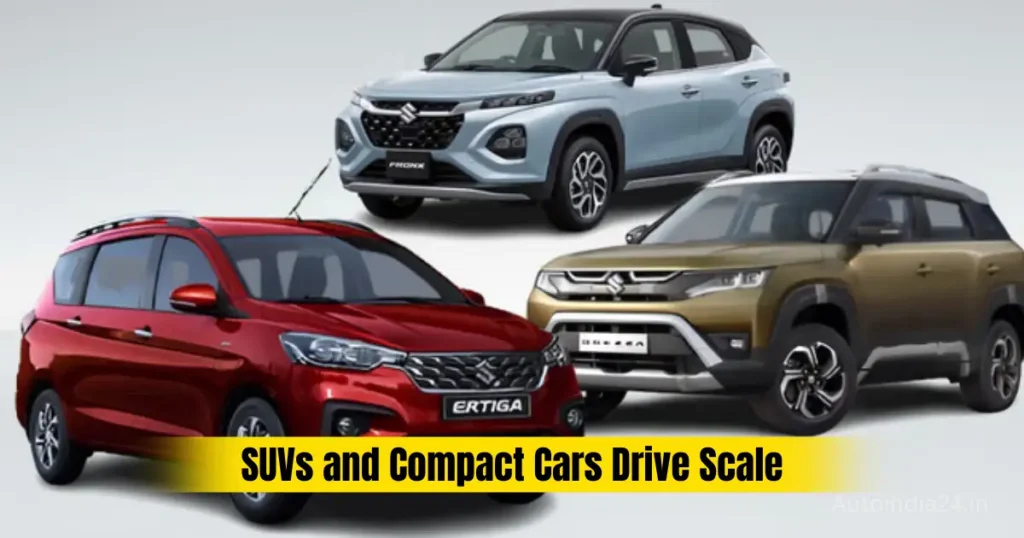
The composition of Maruti Suzuki’s production mix offers key insights into where growth is coming from. Compact cars and utility vehicles continue to form the backbone of volumes, with models such as the Fronx, Baleno, Swift, Dzire and Ertiga emerging as the top contributors.
This mix mirrors broader market trends. While SUVs have gained share across price bands, compact hatchbacks and entry-level sedans remain critical for volumes, especially in non-metro and export markets. Maruti Suzuki’s ability to balance these two ends of the spectrum—mass-market affordability and SUV-led aspiration—has helped it maintain production momentum even as consumer preferences evolve.
Exports Play a Bigger Strategic Role
One of the less discussed but increasingly important aspects of Maruti Suzuki’s 2025 performance is exports. The company recorded its highest-ever annual exports alongside record production, reinforcing India’s growing role as a manufacturing base for global markets.
For Maruti Suzuki, exports serve two purposes. First, they help smooth demand cycles by reducing reliance on domestic market fluctuations. Second, they allow higher utilisation of plant capacity, improving cost efficiency. As global supply chains continue to diversify away from concentrated manufacturing hubs, India’s stability, scale and localisation capabilities are becoming strategic advantages.
Manufacturing Footprint and Capacity Discipline
Maruti Suzuki’s production success is underpinned by a geographically diversified manufacturing footprint. Starting with Gurugram in 1983, the company expanded to Manesar, integrated the Gujarat facility, and more recently added capacity at Kharkhoda. This spread reduces operational risk while enabling flexible allocation of models and volumes across plants.
Collectively, these facilities manufacture 17 models and over 650 variants, supported by a deep, multi-tier supplier ecosystem. High localisation levels have helped Maruti Suzuki maintain cost discipline even as input prices fluctuated globally, while also aligning with national manufacturing priorities.
The company’s stated goal of scaling annual capacity to 4 million units further underscores its long-term confidence in both domestic and export demand. Achieving this would place Maruti Suzuki among the largest single-country automotive producers globally.
Implications for the Indian Auto Industry
Maruti Suzuki Production 2025 has implications beyond its own balance sheet. For suppliers, sustained high volumes translate into better capacity planning, technology investment and employment stability. For the broader industry, it reinforces the idea that India is no longer just a consumption market but a serious manufacturing and export hub.
It also raises the competitive bar. Other manufacturers—both domestic and global—will need to match Maruti Suzuki’s scale, localisation depth and operational efficiency to remain cost-competitive. This could accelerate investments in capacity expansion, supplier development and export-oriented strategies across the sector.
What This Means for Buyers

For Indian car buyers, higher production scale often translates into shorter waiting periods, more stable pricing and quicker rollouts of updates and variants. It also supports better aftersales coverage and parts availability, particularly in smaller towns where Maruti Suzuki has traditionally been strong.
At a time when the market is seeing increasing complexity—with multiple powertrains, stricter regulations and rising costs—scale remains one of the most effective tools for keeping vehicles accessible to a wide customer base.
Looking Ahead- Maruti Suzuki Production 2025
Maruti Suzuki Production 2025 record is not an isolated achievement but part of a longer-term shift toward industrial maturity. The combination of consistent demand, export expansion, localisation and capacity planning suggests that the company is positioning itself for sustained leadership rather than short-term volume wins.
As India’s automotive sector moves into a phase defined by electrification, stricter emissions norms and global integration, manufacturers with scale and manufacturing discipline will be best placed to navigate the transition. Maruti Suzuki’s latest milestone indicates that it intends to remain at the centre of that transformation—both domestically and on the global stage.
Disclaimer: Production figures and analysis are based on official company statements and available industry data at the time of publication. Final numbers may vary slightly.
Also Read: Hyundai Creta Sales 2025: SUV Crosses 2 Lakh Units, Sets New Annual Record

Raj Prajapati is a senior automobile journalist at AutoIndia24, reporting on car, bike, EV, and auto industry developments in India.