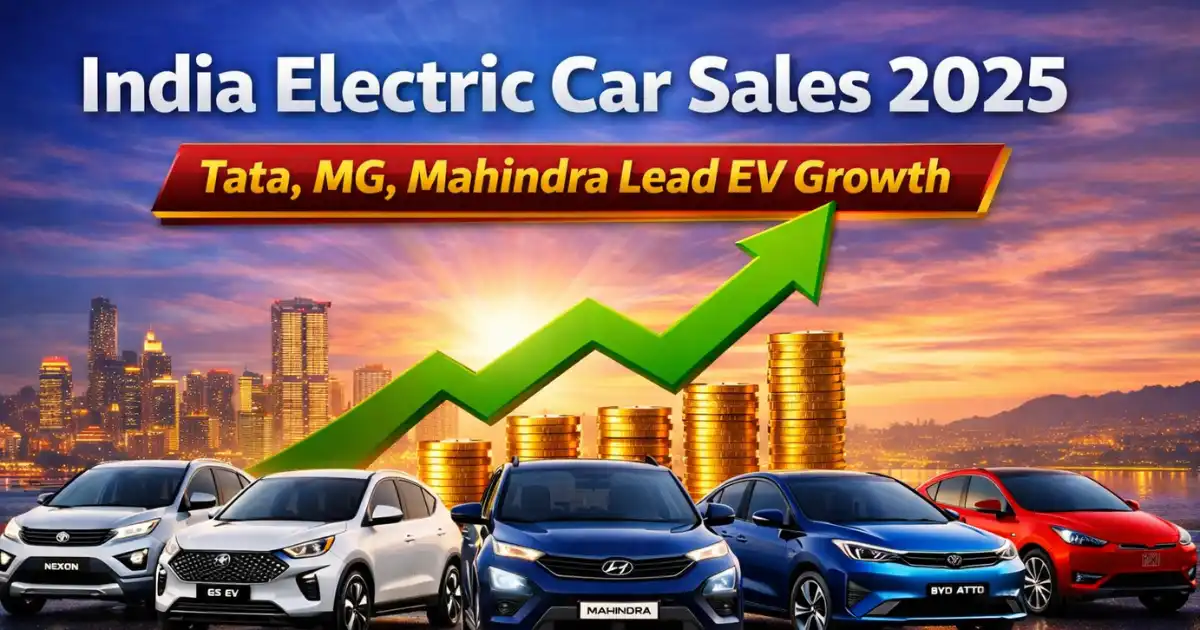
India Electric Car Sales 2025: India’s electric car market recorded its strongest year yet in calendar year 2025, underlining a clear shift in buyer acceptance and manufacturer focus. Data released by the Federation of Automobile Dealers Associations (FADA) shows total electric car retail sales reached 176,817 units, a year-on-year growth of just over 77 percent compared to 99,875 units in 2024.
More importantly, electric cars increased their share of overall passenger vehicle sales from 2.4 percent to 4.0 percent, signalling a structural change rather than a one-off spike.
While the segment is still small in absolute terms, the pace of growth and the reshuffling among manufacturers reveal deeper trends shaping India’s EV transition.
Also Read: Mahindra 2025 Car Sales: Mahindra Becomes India’s No. 2 Carmaker, Overtakes Hyundai & Tata
Market Growth Driven by Choice and Availability
The sharp rise in electric car sales in 2025 can be traced to two key factors: wider model availability and improved consumer confidence. Compared to previous years, buyers now have more options across body styles and price points, from compact SUVs to premium sedans. Manufacturers also ensured better production consistency, reducing waiting periods that had previously constrained EV sales.
Charging infrastructure, while still uneven, expanded meaningfully in urban centres and along major highways. This appears to have reduced range anxiety for early adopters, especially fleet operators and urban private buyers.
Tata Motors Still Leads, but Momentum Has Slowed
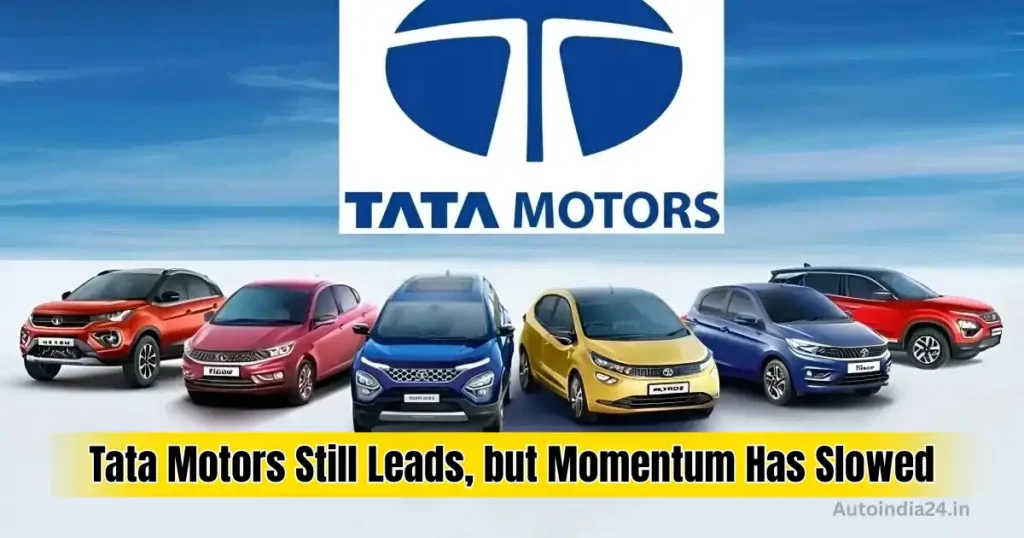
Tata Motors remained India’s largest electric car manufacturer in 2025, selling 70,004 units. However, its year-on-year growth of 13.28 percent was modest compared to the overall market expansion. As a result, Tata lost noticeable market share to faster-growing rivals.
This suggests Tata’s existing portfolio is approaching maturity, with limited upside without major product updates or new launches. For buyers, Tata still offers the widest EV ecosystem, but competition on pricing, range, and features is clearly intensifying.
JSW MG Motor and Mahindra Redefine the Growth Curve
The biggest story of 2025 came from JSW MG Motor India, which sold 51,387 electric cars, registering a 135 percent growth over 2024. Much of this success was driven by the MG Windsor EV, which emerged as India’s single best-selling electric car during its first full year on sale. MG’s strategy of competitive pricing and feature-rich packaging resonated strongly with value-conscious buyers.
Mahindra & Mahindra posted the highest growth rate among major players, with sales jumping 369 percent to 33,513 units. This surge was largely fuelled by the BE 6 and XEV 9e, deliveries of which began in March. Mahindra’s performance highlights how fresh platforms and purpose-built EV architectures can rapidly scale volumes when aligned with consumer expectations.
Hyundai and Kia: High Growth, Limited Volume

Hyundai Motor India recorded a dramatic 635 percent year-on-year growth, selling 6,726 electric cars in 2025. This followed the launch of the locally manufactured Creta Electric. However, despite the growth rate, absolute volumes remain low, suggesting the model has yet to achieve mass-market traction.
A similar pattern is visible at Kia India. With sales of 2,730 units and growth of nearly 558 percent, Kia’s numbers are driven from a low base. Its locally manufactured Carens Clavis EV and imported EV6 and EV9 together have not yet generated sustained demand. For both brands, pricing and perceived value remain key hurdles.
Also Read: Kia EV2 Revealed: Smallest Kia Electric SUV with Up to 448km Range
Premium Brands Show Steady, Niche Growth
Among premium manufacturers, BYD sold 5,402 units, an 88 percent increase year-on-year, while BMW recorded a strong 160 percent growth with 3,195 units sold. These gains indicate a growing but still niche appetite for premium electric cars in India.
Mercedes-Benz India saw a more measured rise of 22.4 percent to 1,168 units, reflecting a stable but cautious luxury EV market.
Mixed Results for Smaller and Newer Players

Not all brands benefited from the EV surge. Citroën India saw EV sales fall by nearly 55 percent to 871 units, largely due to its reliance on a single electric model. Volvo Cars India also recorded a slight decline.
New entrants had a subdued start. VinFast sold 826 units in its first year, while Tesla delivered just 225 cars after entering the Indian retail market. These figures underline the challenges of pricing, localisation, and brand adaptation in India.
India Electric Car Sales 2025- What This Means
For consumers, 2025 marked a transition year. Electric cars are no longer limited to early adopters or premium buyers, but are still far from mainstream. Strong growth from MG and Mahindra suggests buyers are increasingly receptive to well-priced, India-focused EVs rather than imported or lightly adapted models.
At the same time, the slowing growth of the market leader indicates that sustained expansion will depend on continuous product innovation and competitive pricing.
A Market Moving from Experiment to Execution
India Electric Car Sales 2025 demonstrated that demand exists when products align with local expectations. While overall volumes remain modest compared to internal combustion vehicles, the pace of growth and the emergence of new leaders suggest the market is entering a more competitive and execution-driven phase.
The coming years will test which manufacturers can convert early momentum into long-term scale without relying on incentives alone.
Disclaimer: This article is based on retail India Electric Car Sales 2025 data released by the Federation of Automobile Dealers Associations (FADA) and publicly available manufacturer information. Sales figures are indicative of reported registrations and may differ from wholesale or dispatch numbers.
Also Read: Tata Motors PV Shares Fall 4% as JLR Q3 Volumes Decline | Analysis

Raj Prajapati is a senior automobile journalist at AutoIndia24, reporting on car, bike, EV, and auto industry developments in India.