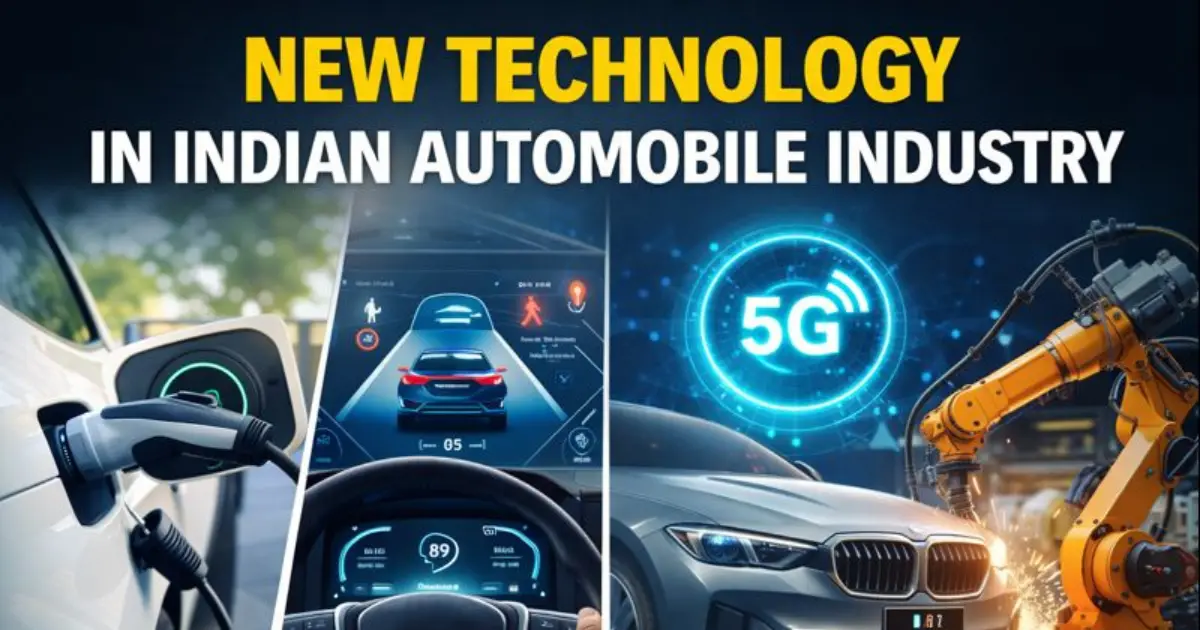
New Technology in Indian Automobile Industry: India’s automobile industry is undergoing one of the most significant transformations in its history. What was once driven largely by mechanical engineering and cost optimisation is now being reshaped by software, electronics, data, and sustainability goals.
Electrification, connected technologies, advanced safety systems, and digital manufacturing are no longer future concepts — they are actively redefining how vehicles are designed, built, sold, and used in India.
This shift is being accelerated by a combination of government policy support, changing consumer expectations, and rapid technological maturation.
Also Read: BMW Upcoming Launches in India 2026: iX Facelift and i5 LWB
Electrification Moves from Experiment to Scale
Electrification is at the centre of India’s automotive transition. As of August 2024, more than 4.4 million electric vehicles had been registered in the country, signalling that EVs are moving beyond early adopters into broader acceptance.
Government initiatives such as FAME and Production Linked Incentive (PLI) schemes have played a crucial role in supporting EV adoption and local battery manufacturing. These policies aim to reduce dependence on imports while improving cost efficiency across the supply chain.
On the technology front, manufacturers are focusing on:
- Improving real-world driving range
- Reducing charging times
- Enhancing battery safety and durability
While lithium-ion batteries remain dominant, research into solid-state batteries and hydrogen fuel cells continues, particularly for long-term and heavy-duty applications. For Indian buyers, this means gradual improvements in affordability and usability rather than abrupt shifts.
Connected Cars Become the New Baseline
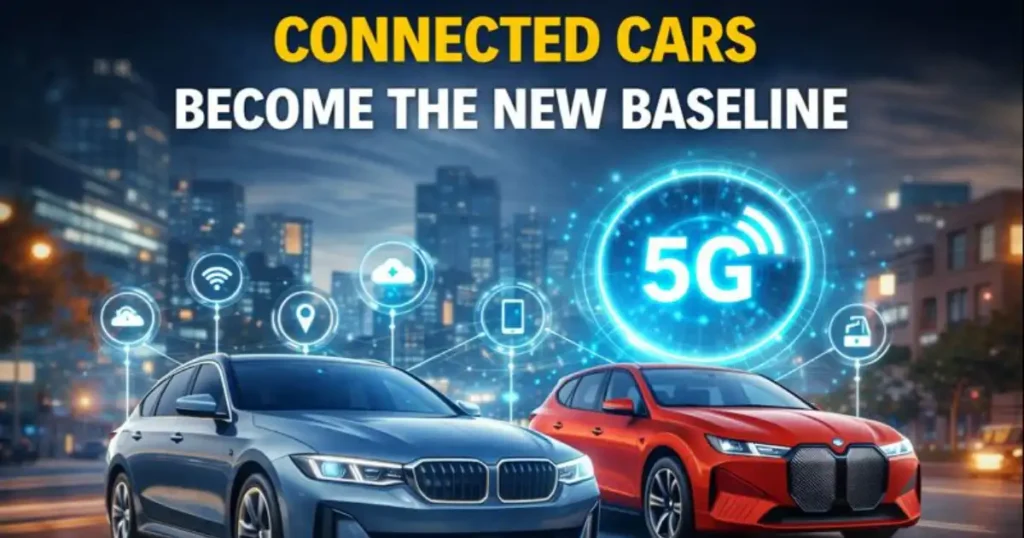
Connectivity is rapidly becoming a standard feature rather than a luxury. Modern vehicles in India are increasingly equipped with IoT-enabled systems that allow real-time data exchange between the vehicle, cloud servers, and user devices.
Connected car platforms enable:
- Remote vehicle diagnostics
- Over-the-air (OTA) software updates
- Live navigation and traffic data
- Smartphone-based control of vehicle functions
With the rollout of 5G networks and smart city infrastructure, vehicle-to-everything (V2X) communication is expected to mature further. This lays the groundwork for safer navigation, predictive maintenance, and more responsive driver assistance systems.
For manufacturers, connected vehicles also open doors to new data-driven services and long-term customer engagement beyond the point of sale.
ADAS Gains Ground Beyond Luxury Segments
Advanced Driver Assistance Systems (ADAS) are no longer restricted to high-end luxury cars. Features such as adaptive cruise control, automatic emergency braking, lane-keeping assist, and blind-spot monitoring are increasingly appearing in mainstream vehicles.
These systems rely heavily on:
- Cameras and radar sensors
- Artificial intelligence and machine learning
- Real-time processing of road and traffic data
While full vehicle autonomy is still a distant goal in India due to infrastructure and regulatory challenges, the steady expansion of Level 1 and Level 2 ADAS reflects growing emphasis on safety.
From a buyer’s perspective, this shift signals a move toward proactive accident prevention rather than reactive protection, aligning with stricter safety norms and rising consumer awareness.
Software-Defined Vehicles Change the Product Lifecycle
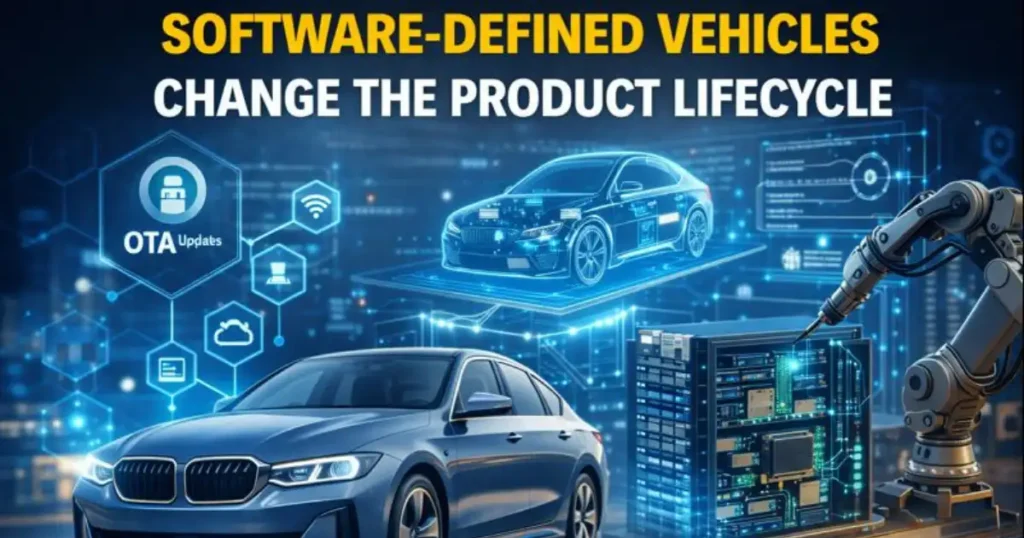
One of the most significant structural changes in the industry is the transition toward software-defined vehicles (SDVs). Instead of multiple independent electronic control units, manufacturers are moving toward centralized computing architectures.
This enables:
- Faster feature updates through OTA software
- Improved system integration
- Longer vehicle relevance cycles
For automakers, SDVs reduce development timelines and allow features to be upgraded post-purchase. For consumers, vehicles increasingly behave like digital devices, evolving over time rather than remaining static.
This also introduces new business models, including subscription-based features and pay-per-use services, though manufacturers are still navigating consumer acceptance in price-sensitive markets like India.
Manufacturing Enters the Industry 4.0 Era
Technological change is not limited to vehicles alone. Indian automotive manufacturing is being reshaped by Industry 4.0 practices, including:
- Robotics and automation
- Artificial intelligence-driven quality control
- Digital twins for process optimisation
- Advanced data analytics and predictive maintenance
These technologies help manufacturers improve efficiency, reduce waste, and maintain consistency across large production volumes. As localisation increases under government schemes, digital manufacturing tools are becoming essential to remain globally competitive.
New Materials and Components Shape Future Mobility
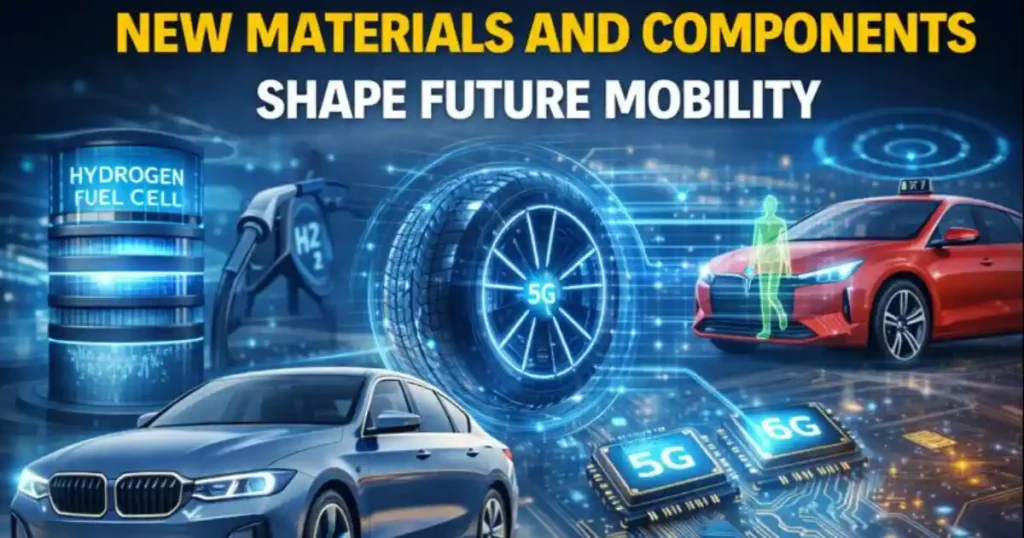
Innovation is also extending to components and materials. Developments in connected tyres, advanced semiconductors, and next-generation connectivity chips (5G, Wi-Fi 7) are becoming critical enablers for modern vehicles.
Meanwhile, alternative power solutions such as hydrogen fuel cells remain under evaluation, particularly for commercial vehicles and long-distance applications, where battery limitations are more pronounced.
What This Means for Indian Buyers and the Industry
For Indian consumers, these changes translate into vehicles that are safer, smarter, and more efficient — but also more complex. Ownership is gradually shifting from purely mechanical familiarity to digital interaction.
For the industry, the challenge lies in balancing innovation with affordability, especially in a market where cost sensitivity remains high. Automakers must also navigate evolving regulations, cybersecurity concerns, and infrastructure readiness.
Looking Ahead- New Technology in Indian Automobile Industry
The New Technology in Indian Automobile Industry is clearly entering a technology-driven phase where software, electrification, and data play as important a role as engines and chassis once did. While adoption will remain gradual and uneven across segments, the direction is clear.
Over the next few years, success will depend less on isolated breakthroughs and more on how effectively manufacturers integrate technology into reliable, accessible products suited to Indian conditions. The transformation is underway — and it is reshaping not just vehicles, but the entire mobility ecosystem.
Disclaimer: This article is based on currently available industry data, policy announcements and technology trends. Developments may evolve over time as regulations, infrastructure and market conditions change.
Also Read: New Bajaj Pulsar 150 Launched at Rs 1.09 Lakh in India

Raj Prajapati is a senior automobile journalist at AutoIndia24, reporting on car, bike, EV, and auto industry developments in India.